
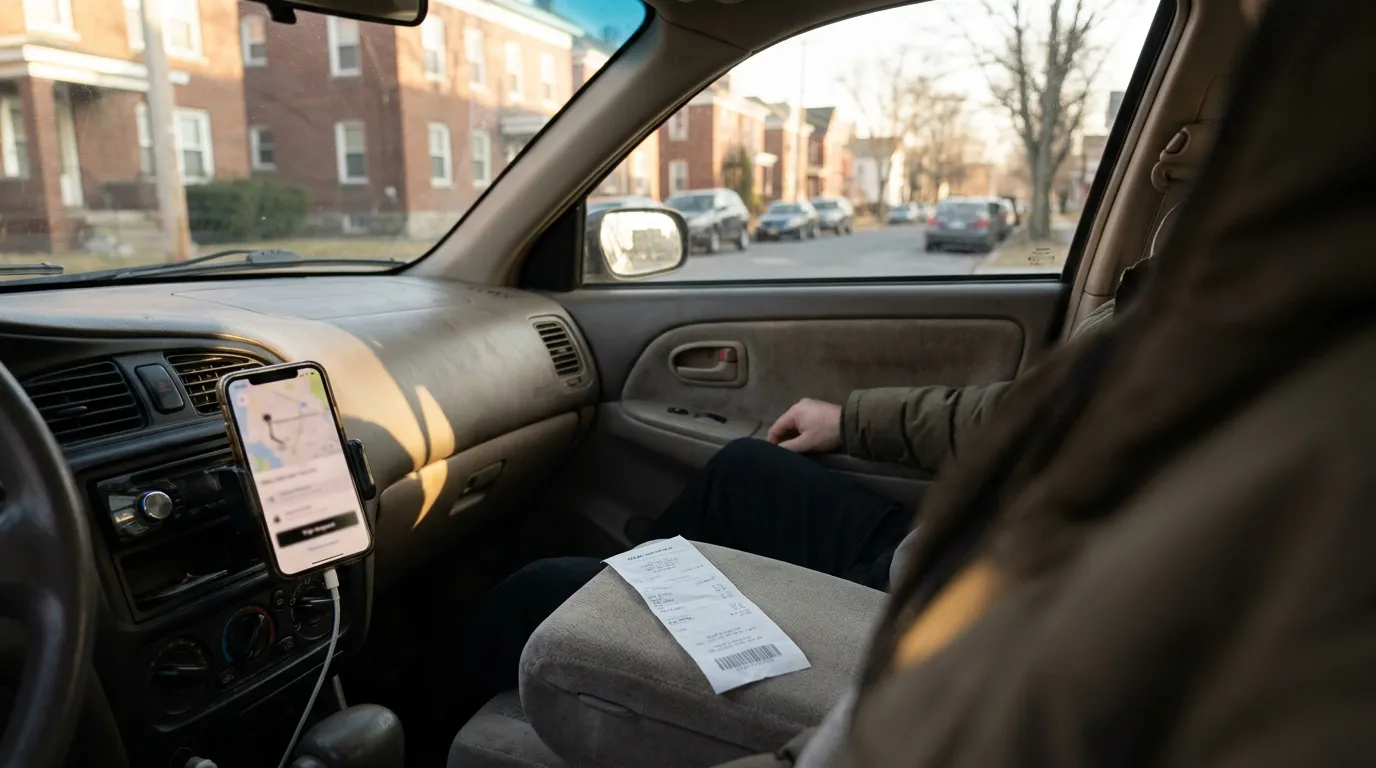
Why the App Screen Decides How Much Coverage Your Albany Claim Can Reach
Key Takeaways: Albany victims prove a driver was on a prearranged trip through app-generated trip data, backed by police reports, scene photographs, in-app crash reports, and insurance cards. N.Y. Vehicle and Traffic Law § 1693 requires at least $1.25 million per occurrence during a prearranged trip, versus roughly $75,000 per person and $150,000 per accident while merely logged on. The higher tier is not automatic; claimants must document app status. Screenshotting the trip page immediately is often the most accessible step, while preservation letters, subpoenas, and trip log discovery may recover GPS data, timestamps, and acceptance times. Passengers first access no-fault benefits covering basic economic loss up to $50,000, with pain-and-suffering claims requiring the serious injury threshold under § 5102(d). Because electronic records can be overwritten and deadlines are strict, acting quickly strengthens claims.
Albany victims prove a driver was on a prearranged trip primarily through app-generated trip data, corroborated by police reports, scene photographs, in-app crash reports, and insurance cards. New York’s transportation network company statute ties required coverage directly to the driver’s app phase. When engaged in a prearranged trip, the statutory floor is substantially higher than when merely logged on and waiting, a distinction insurers scrutinize in serious-injury cases involving fractures, significant disfigurement, or permanent limitation of body function.
If you or a family member suffered a serious injury in an Uber or Lyft collision in the Capital Region, the team at Hacker Murphy can begin preserving trip records before they are overwritten. Call 518-274-5820 or contact us now to discuss your options.
What New York’s Prearranged Trip Definition Actually Means for Coverage
New York’s TNC financial responsibility statute draws a bright line between two app phases, and that line controls the money. Under N.Y. Vehicle and Traffic Law § 1693, one set of minimum coverage requirements applies while the driver is logged on but not on a trip, and a separate, higher set applies while engaged in a TNC prearranged trip. Those minimums are statutory, meaning carriers cannot unilaterally redefine which tier applies.
The financial gap between phases drives most disputes. For the prearranged-trip phase, the TNC financial responsibility statute requires liability coverage of at least $1.25 million per occurrence for bodily injury, death, and property damage. When a driver is only logged in and waiting, statutory minimums are $75,000 per person and $150,000 per accident for bodily injury, with $25,000 in property damage.
The Coverage Tiers at a Glance
| Driver’s App Status | Coverage Generally Available |
|---|---|
| Offline / app closed | Driver’s personal auto policy only |
| Logged on, awaiting a request | Statutory minimums of $75,000/$150,000 bodily injury and $25,000 property damage |
| Request accepted or passenger onboard | Statutory TNC tier, at least $1.25 million per occurrence under § 1693 |
Why the $1.25 Million Rideshare Insurance Coverage New York Standard Hinges on Proof
The higher tier is not automatic. The prearranged-trip layer does not attach simply because a crash involved an Uber or Lyft vehicle; it depends on the driver’s app phase at the collision moment. The practical consequence: the burden of documenting the app-based trip falls on the claimant. Establishing that the driver had accepted a request or was carrying a passenger often unlocks the top layer.
New York Insurance Law supplies the vehicle through which that layer exists. The transportation network company group policy is addressed under N.Y. Insurance Law § 3455, which ties terms like "transportation network company," "TNC vehicle," and "group member" back to Article 44-B of the Vehicle and Traffic Law. Trip status is the gateway to higher limits under that policy.
The Evidence That Establishes Prearranged Trip Proof
App data is often the most accessible and persuasive record a passenger controls. Guidance on rideshare collisions consistently advises screenshotting the trip page immediately, capturing ride status, driver identity, and crash time in one image. That screenshot is often the only version a claimant holds independently of the company.
Corroborating records give app data context carriers cannot easily dismiss. Adjusters rarely challenge a single document in isolation; they challenge gaps between documents. The following materials close those gaps:
- The police report and report number, which time-stamps the collision independently
- Scene photographs and video showing the vehicle, position, and any TNC decals
- The in-app accident report submitted to Uber or Lyft
- Witness contact information, particularly from other passengers or nearby motorists
- The driver’s insurance identification cards produced at the scene
That last item is underused. Section 1693 contemplates proof of TNC coverage through an insurance identification card in addition to the article-six card otherwise required. That separate card is a statutorily contemplated marker of TNC status. Its presence or absence at the scene can be meaningful, though it reflects program participation rather than conclusively fixing the app phase at impact.
💡 Pro Tip: Screenshot the trip page before closing the app, including driver’s name, vehicle, pickup time, and route. Reconstructing that screen weeks later is far harder.
How Trip Records Move From Request to Litigation
Trip logs generally arrive through preservation demands first, formal discovery second. We typically send written preservation letters to the transportation network company and every potentially involved carrier early, then follow with subpoenas or document demands once suit is filed. Uber trip log discovery and Lyft ride records may produce GPS pings, timestamps, driver acceptance times, and passenger drop-off data, subject to court-permitted discovery scope.
Notice problems are a common stall point, and New York law may soften some. Under N.Y. Insurance Law § 3461, notice given to a shared vehicle owner, driver, program administrator, or their insurer is deemed notice to all appropriate parties and insurers, and recipients must forward that notice. In overlapping personal and commercial coverage situations, this shared vehicle notice of claim rule may reduce the risk that claimants are prejudiced for serving the wrong carrier while trip status is being sorted. Policy deadlines still apply.
Where App Status Disputes Typically Arise
Disputes cluster around recurring fact patterns. A driver may have ended one trip seconds before impact, cancelled a request, or been driving toward a pickup without formal acceptance logged. If your claim is heading in that direction, our discussion of what happens when app status is disputed walks through how those conflicts are typically resolved.
How No-Fault Interacts With the Rideshare Layer
Albany rideshare passengers generally look first to New York no-fault benefits. Basic economic loss, including medical bills and lost earnings, is covered up to $50,000, with internal sublimits such as lost earnings capped at $2,000 per month for up to three years. Recovery for pain and suffering beyond that requires meeting the serious injury threshold under N.Y. Insurance Law § 5102(d), which encompasses categories such as fracture, significant disfigurement, and permanent consequential limitation of use of a body organ or member. No-fault also carries strict filing deadlines, including a 30-day window to submit the application.
Priority-of-payment rules add a wrinkle worth confirming early. Which policy provides the passenger’s no-fault benefits depends on New York’s priority-of-payment rules, and that sequencing may affect how quickly medical treatment gets funded. Our Albany rideshare injury attorney team routinely sorts this out before bills accumulate.
Frequently Asked Questions
1. What counts as a prearranged trip under New York law?
Under the New York prearranged trip definition in Article 44-B of the Vehicle and Traffic Law, the prearranged-trip phase is distinct from merely being logged onto the digital network. The higher statutory coverage tier under § 1693 applies while the driver is engaged in that prearranged trip, from acceptance of the request through the passenger’s exit.
2. Can I still recover if the driver had not yet accepted my ride request?
Possibly, but required coverage is typically far lower. In the logged-on-and-waiting phase, statutory minimums are $75,000 per person and $150,000 per accident for bodily injury.
3. What if I did not screenshot the trip page?
Trip data may still be obtained through preservation demands and formal discovery. Ride receipts, email confirmations, payment records, and phone location history can often supplement missing screenshots, though earlier action generally produces better rideshare accident evidence in Albany.
4. Does my own no-fault coverage matter if the rideshare policy applies?
Yes. No-fault benefits generally address basic economic loss up to $50,000, while pain-and-suffering claims require satisfying the serious injury threshold. Which policy pays first depends on applicable priority-of-payment rules and collision facts.
5. How quickly should I contact an Albany Uber crash lawyer?
As soon as practical. Electronic records can be overwritten, witnesses relocate, and New York’s limitations periods are generally applied strictly. Most negligence claims carry a three-year statute of limitations, but shorter deadlines and notice-of-claim requirements can apply when a municipality or public authority is involved.
What to Do Next After a Capital Region Rideshare Collision
Start with documentation, then move quickly to preservation. Screenshot the trip page, obtain the police report number, photograph the scene and any TNC decals, report the crash through the app, and seek prompt medical evaluation so injuries are documented contemporaneously. Then have counsel send preservation demands before the company’s retention cycles run. Proving rideshare trip status is ultimately an evidentiary project, and the $1.25 million rideshare insurance coverage New York statute can make that project financially significant for anyone with a threshold-level injury.
No outcome can be promised, and every rideshare claim turns on its own facts. Claimants who capture TNC trip records evidence early may be in a materially stronger position than those who rely on the carrier’s account of the app screen. If you were seriously injured as a passenger, another motorist, a pedestrian, or a cyclist, the sooner the record is locked down, the better.
To discuss preserving app data and identifying which coverage layer applies to your case, reach Hacker Murphy at 518-274-5820 or schedule a consultation today.
Disclaimer: This content is for informational purposes only and is not legal advice. Every case is unique, and results may vary. Consult an attorney about your specific circumstances.